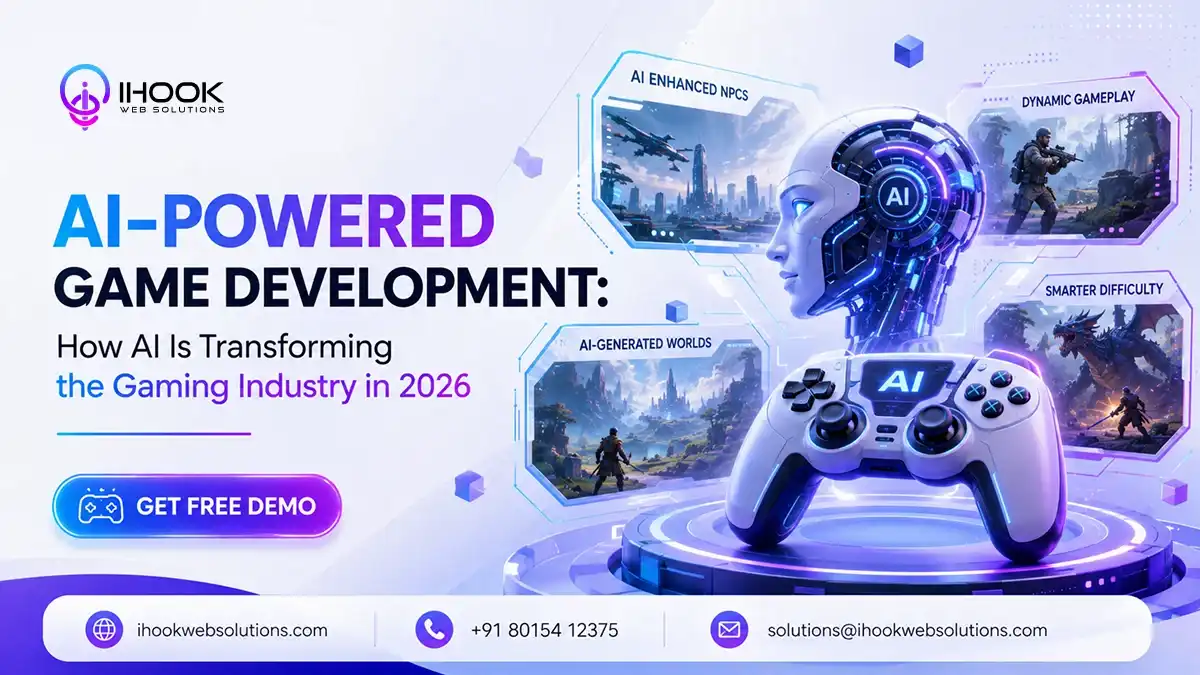
Introduction
The gaming industry is entering a stage where artificial intelligence is becoming a part of the development process, the way games are played and the experience players have. From making characters that react better to player actions to automating testing and creating game content, AI is helping teams make detailed and unique gaming experiences.
AI-powered game development is no longer for small experiments. Developers are using intelligence to improve how games are designed to handle tasks that repeat themselves to learn how players act and to build changing worlds.
As games keep changing in 2026, knowing how AI works in game development can help companies and developers find opportunities while making smarter choices about technology.
What Is AI-Powered Game Development?
AI-powered game development is about using this technology to help with the different parts of making and running a game.
The old way of making games relies a lot on rules that are already set and content that people make by hand. Artificial intelligence can bring in systems that learn from information, make content react to what players do and do some development tasks on their own.
Artificial intelligence can be used for things in a project, such as:
- Intelligent characters in the game that are not played by people
- Making game content in a way that is not completely planned out
- Looking at how players behave
- Testing the game automatically
- Changing how hard the game is based on how the player is doing
- Making the game experience special for each player
- Creating characters and the world they are in
- Systems, for voices and conversations
- Looking at how people play the game and giving suggestions
The goal is not just to put intelligence in a game. The real benefit comes from using it in places where it can make the game more fun, make it easier to develop or make the experience better for the player. Artificial intelligence is used to improve the game and the experience of the player.
How AI Is Changing Game Development in 2026
AI is changing how games are made in both technical and. Game makers can use tools to make boring tasks faster so they can focus more on how the game plays, the story, the look and how players connect with the game.
One big part of this is how non-player characters act. By having the same answers every time, AI-powered characters can respond in a more natural way when players do different things. This makes the game world feel more alive and not so easy to guess.
AI can also help with creating game content. Developers can set up systems that build places, tasks, items or other parts of the game based on rules. This helps make more different game worlds without having to design every single part by hand.
Another area that is growing is testing. Games have many possible actions, so checking everything is a big job. AI systems can help find repeating problems, spot errors and help the testing team try more situations.
Key Applications of AI in Gaming
Intelligent NPCs
Non-player characters are a part of many games. Artificial intelligence can help the people who make games create characters that do things based on what the player's doing, what is happening in the game and how things are changing around them.
This makes the game more fun because the non-player characters can adapt to what's going on. It makes the missions, conversations, fighting and exploring feel like you know what is going to happen.
Personalised Gameplay
Everyone who plays games is different. I like different things. Artificial intelligence systems can look at how people play and help make the game fit each person.
For example, the game can make it easier or harder, suggest things to do or change some parts of the game based on how the player's playing.
Procedural Content Generation
Making all the parts of a game by hand can take a lot of time and money. Artificial Intelligence can help make versions of environments, objects, levels and other things in the game.
The people who design the game are still very important because they decide what the game should look like and how it should work.
Automated Game Testing
We need to test games to make sure they work properly. Artificial intelligence can help with the parts of testing and find problems that we might not see.
This is especially helpful for games that have a lot of different parts and can be played on different devices.
AI-Generated Assets and Content
Artificial intelligence tools can help with making some parts of the game, like ideas, textures, talking, movements and other things that go into making the game.
We still need people to check everything to make sure it is good, original and fits with the rest of the game.
Benefits of AI-Based Game Development
The use of intelligence in making games is becoming more common because of many useful advantages.
- Faster ways to create games: AI can do tasks that are done over and over, which lets the people working on the game spend more time on important parts of the work.
- Reactions in games: Smart systems can help games respond to what players do and to what is happening in the game.
- Experiences: Information about players can be used to change how hard the game is and to give them content that is just right for them.
- Testing: AI can help the people making the game check many different situations quickly.
- Scalable content creation: Procedural and generative approaches can help make game worlds and many different kinds of content.
- Player insights: AI can help look at how players play the game and find out where they like to play, where they have problems or where they stop playing.
These benefits depend on how AI's used. Technology, by itself, does not mean a game; good results need solid game design, the right data, testing and people watching over everything.
AI-Powered Gaming and the Future of Player Experiences
The future of AI-powered gaming will likely be experiences that react more naturally to individual players.
Games could become increasingly adaptive, with environments, characters, challenges and recommendations adapting to gameplay behaviour.
AI could also make storytelling more interactive. Some game experiences might be able to adapt to decisions, actions and progression, rather than going through the exact same sequence for every player.
At the same time, developers need to consider important issues including data privacy, content quality, computational requirements, intellectual property and responsible use of content produced by AI.
Rather than trying to replace the creative process altogether, the best approach is probably to combine AI’s capabilities with human creativity.
Choosing an AI Game Development Company
For businesses planning to undertake an AI-based gaming project, it is important to look beyond technical capabilities while choosing an AI game development company.
Look for a team that has experience with game design, artificial intelligence (AI) technologies, backend development, graphics, testing, security and the gaming platform you are targeting.
Also, the objectives of the project must be discussed before selecting the technologies. The AI architecture for a simple mobile game can be very different from that of a large multiplayer or Web3 gaming platform.
Proposed technology stack, development process, AI use cases, testing approach, scalability requirements and long term maintenance plan should be explained by a development partner.
What Are AI Game Development Services?
AI game development services can cover different parts of the development lifecycle, depending on the project's requirements.
These may include:
- AI integration
- NPC and behavioral AI development
- Procedural content generation
- AI-powered game mechanics
- Game analytics
- AI-assisted testing
- Personalized gameplay systems
- Generative AI integration
- Backend and API development
- Game maintenance and optimization
The required services will depend on the type of game, target audience, platform, business model, and expected scale.
Conclusion
Artificial intelligence is growing more important in today's game development. Its worth depends on how carefully it is used. From non-player characters and unique gameplay to automatic testing and creating content, artificial intelligence can help game makers make more lively and interesting games.
In 2026 the attention is moving past just trying out intelligence toward discovering real ways to use it throughout the game-making process. By mixing good game design with the artificial intelligence tools, companies can discover new chances while making sure creativity and the player experience stay important.
For businesses planning to build an AI-powered gaming product, IHook Web Solutions offers game development expertise and modern technology solutions to help turn gaming concepts into scalable digital experiences. Choosing the right technology approach and an experienced development team can make a significant difference in bringing an AI-powered game to market.
Frequently Asked Questions
1. What is the meaning of AI powered game development?
AI-powered game development involves leveraging AI technologies to boost various aspects of game development and gameplay, such as NPC behavior, testing, content creation, analytics, and personalization.
2. What are some examples of how AI is being applied to games?
Intelligent NPCs, procedural content generation, player behavior analysis, automated testing, adaptive difficulty, and personalized experiences are all possible with AI.AI can be leveraged to provide intelligent NPCs, procedural content generation, player behavior analysis, automated testing, adaptive difficulty, and personalized experiences.
3. What are some of the advantages of AI game development?
AI can be used to automate repetitive tasks, enhance the efficiency of tests, design adaptive gameplay, analyze player actions, and contribute to creating more responsive gaming experiences.
4. Is it possible to make a complete game with AI?
While AI can help with various parts of developing a video game, it's unlikely that it could generate a fully-fledged, high-quality video game without the involvement of humans in areas like game design, programming, art direction, testing, story development, optimization and quality control.
5. How to select an AI game development company?
Take into account the company's experience in game development, AI integration, technology, portfolio, development process, testing practices, scalability, and post-launch support.